If you wear a GPS watch outdoors — and most serious walkers, runners, and cyclists do — you’ve probably never given much thought to the strap holding it to your wrist. The watch gets reviewed carefully. The strap just comes with it.
But the strap matters more than most people realise. The wrong material can cause skin irritation after a long day on the hill. A worn buckle can fail at the worst possible moment. And a strap that doesn’t dry quickly becomes genuinely unpleasant after a river crossing or a sudden Scottish shower.
Here’s what the evidence from outdoor use actually shows — and which materials perform best across the full range of conditions outdoor adventurers encounter.
Why the Factory Strap Is Usually Worth Replacing
Most GPS sport watches — Garmin, Suunto, Polar, Coros — ship with a resin or basic silicone strap. These are functional at launch but they’re designed to be inoffensive to the widest possible range of buyers, not optimised for sustained outdoor use.
Resin straps harden and crack with UV exposure after months of use. Basic factory silicone can develop odour under repeated heavy perspiration. The buckle hardware is often hollow and lightweight in a way that prioritises cost over durability.
The aftermarket gives you access to materials specifically designed for the conditions you’re actually using the watch in. It’s the same logic as upgrading your base layer or your footwear – the same function, significantly better performance.
The Materials Guide
Silicone — the best all-round active strap
Medical-grade silicone is the material that performs best across the widest range of outdoor activities. Lightweight, hypoallergenic, fully waterproof, easy to clean, and available in a range of colours that suit both casual and technical outdoor use.
The key qualities for outdoor use:
- Waterproof — silicone doesn’t absorb water. After a river crossing, a rain shower, or a kayaking session, it dries immediately and maintains its shape.
- Hypoallergenic — medical-grade silicone doesn’t cause skin irritation under sustained sweating, which matters on multi-day walks or long-distance events.
- Easy to clean — wipe with a damp cloth. After a muddy hill day, it takes thirty seconds to clean properly.
- Comfortable from first wear — no breaking-in period. Silicone is soft and flexible immediately, which matters when you’re wearing the watch for eight to twelve hours on the hill.
The best choice for: hiking, trail running, cycling, gym training, and any activity where comfort and easy maintenance are the priority.
Ballistic nylon — the military-proven outdoor standard
Ballistic nylon has been the material of choice for military watches since the British Ministry of Defence specified it in 1973. The same qualities that made it the MOD’s choice — durability, water resistance, light weight, and security — make it excellent for outdoor use today.
The single-pass construction is particularly worth noting for outdoor adventurers. A standard two-piece strap attaches via two separate spring bars — if one fails on a remote hill, the watch falls. The single-pass nylon construction threads one continuous piece of fabric over both spring bars and behind the watch case. If one spring bar fails completely, the watch stays on your wrist. For watches worn during technical scrambling or via ferrata, this matters.
Nylon also dries rapidly after water exposure, resists abrasion from pack straps and gear, and weighs almost nothing on the wrist.
The best choice for: mountaineering, scrambling, via ferrata, and any activity where watch security is a genuine concern.
FKM rubber — for sustained water exposure
FKM fluorocarbon rubber is the professional-grade material used on Omega Seamaster, Rolex Submariner, and Tudor dive references. Fully resistant to seawater, chlorine, UV, and sunscreen. The correct choice for kayaking, open water swimming, and any activity involving sustained submersion.
Harder and firmer than silicone — it provides positive grip against the wrist during water activity in a way that softer materials don’t.
The best choice for: kayaking, canoeing, open water swimming, and coastal adventures.
Leather — leave it on the café terrace
Full-grain calfskin leather is beautiful and develops a wonderful patina with wear. It is also the wrong choice for outdoor activities. Leather absorbs sweat, degrades with repeated water exposure, and requires drying time after field use. Save leather for the café at the trailhead — not the trail itself.
Choosing for Your Garmin or Suunto
The most common question for GPS watch owners choosing an aftermarket strap is lug width — the gap between the watch lugs in millimetres that determines which straps fit.
Common lug widths for popular outdoor watches:
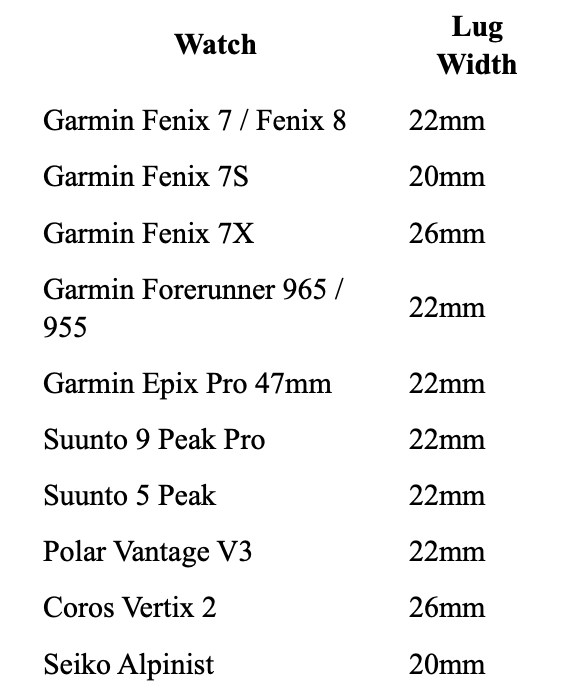
Measure the gap between your watch lugs before ordering. Most GPS outdoor watches use 22mm — but always confirm your specific model.
The One Rule
Match the material to the conditions, not to the watch. A Garmin Fenix on a quality silicone strap is better equipped for a full day on the Munros than the same watch on a worn factory resin strap, regardless of how the resin looks when new. The strap is part of the kit. Treat it accordingly.
Silicone watch bands from CNS Watch Bands are available across all lug widths from 16mm to 26mm — including 22mm and 26mm for larger GPS sport watch cases — in black, white, grey, and a range of additional colours. Medical-grade silicone throughout. From $9.95, ships worldwide including to the UK.
Maintenance
Silicone — wipe with a damp cloth after outdoor use. Wash periodically with mild soap and water. Air dry. Will outlast the watch if maintained.
Nylon — rinse with clean water after salt water or heavy sweating. Wash with mild soap occasionally. Air dry away from direct heat.
FKM rubber — rinse with clean water after use. Wipe dry. No conditioning required.