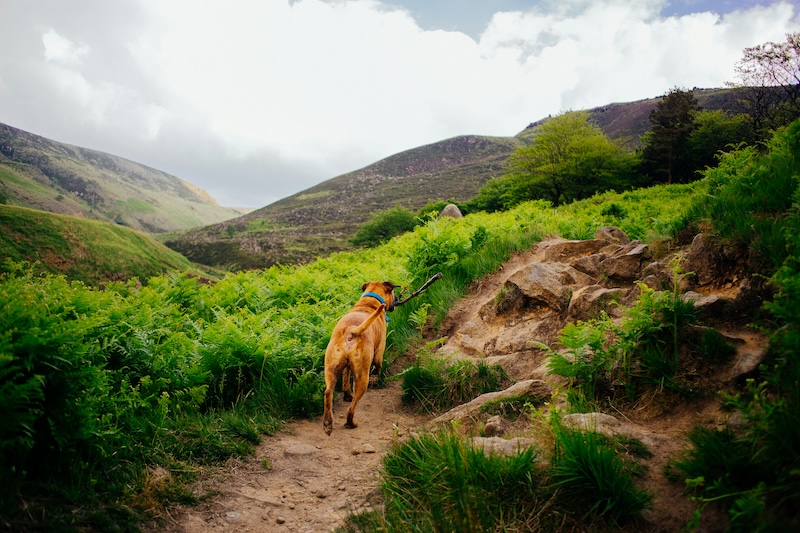
A healthy adult dog needs between 30 minutes and two hours of walking a day, depending on breed, age and fitness. A fit, conditioned dog from a working or gundog breed can then manage a 20km to 30km hill day. A puppy, a senior dog or a flat-faced breed cannot, and should not be asked to.
That is the short answer. The longer answer is explained below.
How far should you walk your dog each day?
Most adult dogs need a daily walk of 30 minutes to two hours, split into one or two outings. Toy breeds sit at the low end, at 30 to 45 minutes. Collies, huskies, Labradors and spaniels sit at the top, at 90 minutes to two hours or more.
In distance terms, that works out at roughly 2km to 4km a day for a small dog, 5km to 8km for an average family dog, and 10km or more for a working breed that is used to it.
Time is a better measure than distance for everyday walks. A dachshund covering 3km on a lead has worked as hard as a pointer covering 8km off it. Terrain, pace and how much the dog is zig-zagging all change the sums, which is why I would never treat a distance figure as a target to be hit every day.
How far can a dog walk in a day?
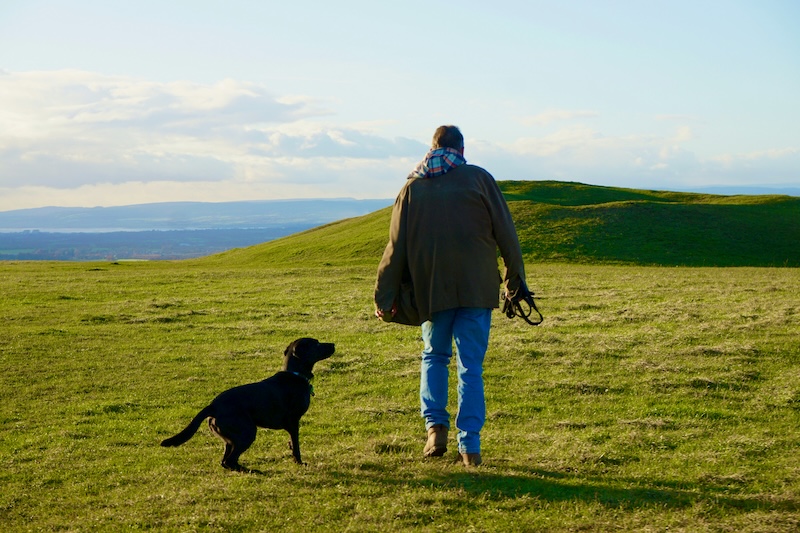
A fit adult dog from a working, herding or gundog breed can walk 20km to 30km in a day on hill terrain, provided it has built up to that over weeks. Medium-energy dogs top out at around 10km to 15km. Small, giant and flat-faced breeds manage 3km to 8km.
Those top figures assume a dog that already walks every day and has done several longer outings first. They do not apply to a dog that does 40 minutes round the park and is then driven to Glen Coe on a Saturday.
Fitness matters more than breed once you get past the basics. I know a Border Terrier that has done 40 Munros and a young Labrador that struggled on a 12km glen walk because it had spent the summer on a lead by the sea. Breed sets the ceiling. Conditioning decides how close to it your dog actually gets.
How does age change the distance a dog can walk?
Puppies follow the five-minute rule: Five minutes of formal walking per month of age, up to twice a day, until they are fully grown. Adult dogs from around 18 months to seven years can build up to long days. Senior dogs need shorter, flatter and more frequent walks.
The five-minute rule is the one figure every new owner should know. The Royal Kennel Club sets it out in its guidance on walking puppies and adult dogs, and it means a four-month-old pup gets 20 minutes of lead walking, not a two-hour ramble over Ben Lomond. Growth plates in the legs are still soft until 12 to 18 months in most breeds, and up to two years in giant breeds. Repetitive impact on steep ground before then is how you end up with joint problems at age six.
Senior dogs, which for most breeds means eight years and up, still want to be out. They just want it in 20 to 40 minute chunks on the flat, and they take longer to recover. A Labrador that did 25km hill days at four can still do a 10km loch-side loop at ten, but not three days on the trot.
How do you build a dog up to a long hill day?
Build a dog up to a long hill day by increasing weekly distance by no more than 10 to 15 per cent, adding ascent before adding distance, and giving one full rest day after every long outing. From a daily hour, allow eight to twelve weeks to reach a 20km Munro day.
This is exactly how I would train a person for a first big hill, and the dog is no different.
Start by working out where your dog actually is now, rather than where you think it is. I found it useful to run the numbers through a calculator that works out how much daily walking your dog needs, which takes breed, age and weight and gives a daily minutes guide, along with the sort of advice on puppies, senior dogs and over-exercising that I have been repeating for years. Treat that daily figure as your baseline, then build from there.
A rough progression for a fit adult dog might look like this. Weeks one and two, two walks of an hour on rolling ground. Weeks three and four, one walk stretched to 90 minutes with a proper climb in it. Weeks five and six, a 10km to 12km outing with 400m to 500m of ascent. Weeks seven and eight, a 15km day with a Corbett-sized hill. After that, the first Munro day is a step up rather than a leap.
Watch your dog on the day after each longer outing. That is where the real information is.
Does heat and terrain change how far a dog can walk?
Heat and terrain both cut a dog’s safe distance sharply. Above 20°C, halve the planned distance and walk early or late. Bog, boulder fields and steep grass roughly double the effort of a flat kilometre. Snow and ice shorten a day further for short-legged and thin-coated dogs.
Dogs cannot sweat through their skin, so a warm, humid Scottish afternoon with no wind is harder on them than on you. Anything above about 25°C is a no for dogs, whatever the breed, and flat-faced dogs such as pugs and French bulldogs struggle from the high teens. There is a sensible rundown of when it is too hot to walk your dog that lands on the same 25°C line and covers pavement heat and how to cool a dog down afterwards.
Terrain is the bit owners underestimate. A 15km day over the Cairngorm plateau, with boulders and coarse granite, is nothing like 15km on a forest track. Paw pads wear, not on the climb, but on the long stony descent when the dog is tired. Check pads at every stop, carry water and a collapsible bowl, and in Scotland keep the dog close on open hill from April to July for ground-nesting birds, and on a lead near sheep at all times.
What are the signs you have walked your dog too far?
The signs a dog has walked too far are lagging behind, lying down mid-walk, sustained heavy panting after a rest, limping, worn or bleeding pads, and stiffness or reluctance to walk the next day. Any one of those means shorten the next outing and rest for two days.
Here is the misconception to fight against: People say a dog will tell you when it has had enough. Some will. Collies, spaniels and most gundogs will not. They run on drive, not sense, and will keep going until something gives. It is your job to call it, not theirs.
The next-day check is the one to rely on. If your dog bounds to the door in the morning, the distance was fine. If it is slow to get up, stiff on the stairs, or off its food, you overdid it, and the following week’s plan comes down a notch. Persistent lameness beyond 48 hours, or any swelling of a joint, is a vet appointment, not a wait-and-see.
Should you take your dog hill walking at all?
Yes, if the dog is a healthy adult, has been built up over weeks, and you are willing to turn back for it. Hill walking suits medium and large active breeds best. Puppies under a year, senior dogs and brachycephalic breeds are better on glen and loch-side routes.
A well-conditioned dog is one of the best walking companions there is. They just need the same respect you would give a friend new to the hills: A sensible plan, a gradual build-up, and the good grace to cut the day short when they are done.
Pick a modest hill first. Take the water. And leave the big traverse until the dog has earned it.