
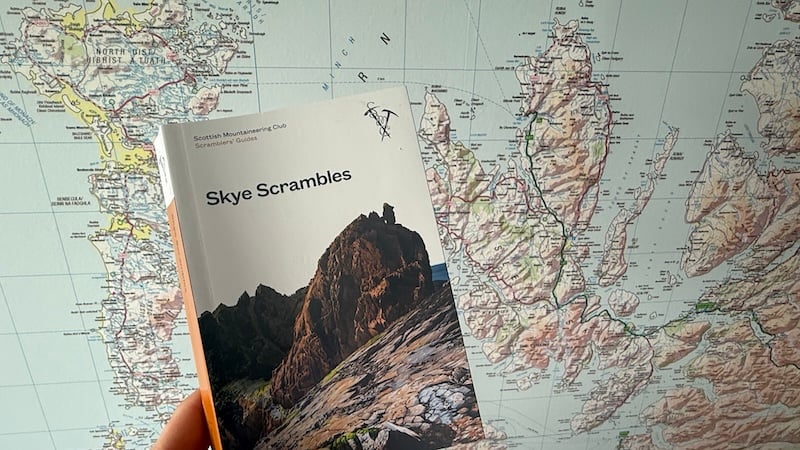
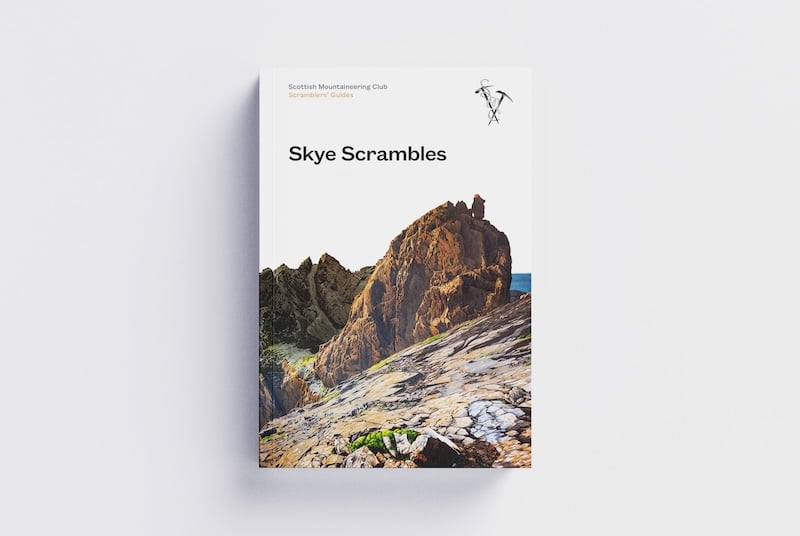
The new and fully-revised edition of the Scottish Mountaineering Club guidebook, Skye Scrambles, has been published by Scottish Mountaineering Press. The chunky, pocket-sized book is written and updated by Noel Williams, a well-respected Scottish climber and mountaineer.
Like most people, when I think of the Island of Skye, it’s the Cuillin Ridge that first comes to mind and then the many honeypot tourist attractions, such as The Fairy Pools, The Old Man of Storr and the Quiraing.
I am not a fan of the long drops and exposure on the ridge and I prefer to avoid the crowds of visitors who flock to the best-known hotspots. So, it is very refreshing to find a book that showcases a wealth of alternative destinations.
Yes, Noel has included routes in the the feisty Cuillin, with its magnificent gabbro mountains, but he has also outlined many other walks, scrambles and low-grade rock climbs in much quieter and lesser-known locations, dotted all over Skye.
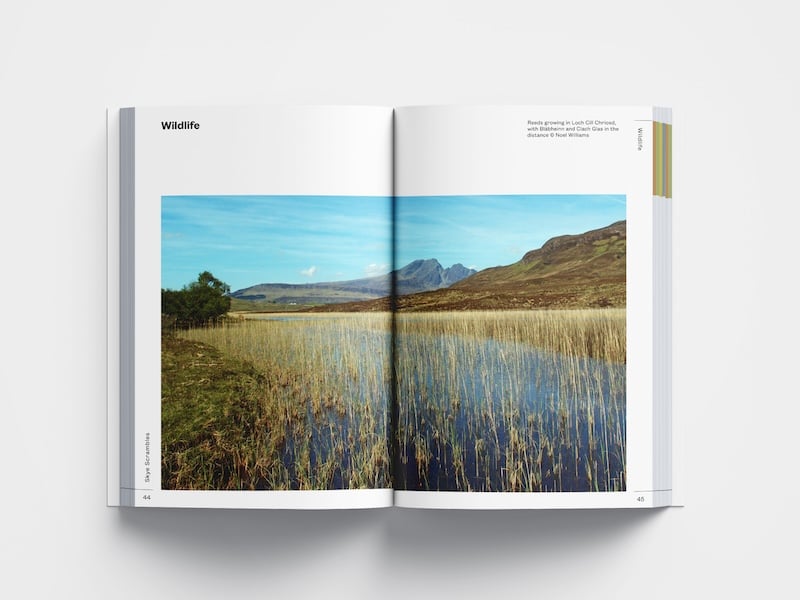
In addition, the book has more than 30 routes that offer insights into the local wildlife, history and geology.
Noel’s decade of revising Skye Scrambles guidebook
Noel has spent the last decade fully revising the book – and adding more than 30 routes to the comprehensive cross-island collection. He has also supplemented the guide with his expert insight into the wildlife, history and geology of the island.
Noel says: “No one could have foreseen the enormous increase in the number of visitors to Skye over the last decade – and since the previous Skye Scrambles edition. Several locations on the island now attract a huge number of visitors.
“Fortunately, there are still many places on the island where you can have more of a wilderness experience. I hope the routes described in the new guidebook will give hill-goers plenty of ideas.”
More details: Skye Scrambles
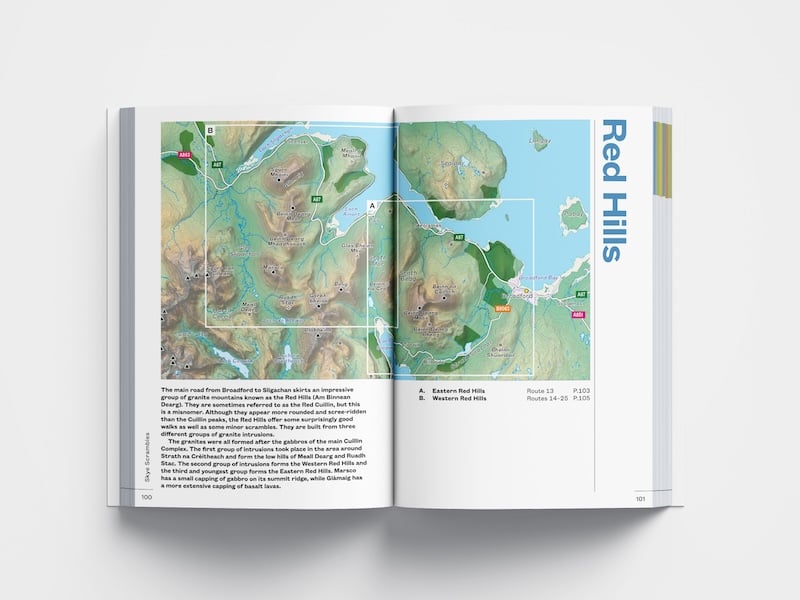
The third edition of the SMC guidebook Skye Scrambles includes 234 routes with venue and route information. The book is presented in a contemporary style with high-resolution photo diagrams and maps that offer clarity and details of accessibility. It’s a very detailed guide.
There are routes to suit all tastes and aspirations, from short, accessible outings to more committing adventures, including classics such as the Trotternish Ridge on Skye’s northern peninsula and the “Main Ridge Traverse” of the Cuillin.
My thoughts: Skye Scrambles
Flicking through the well-produced book, I find all kinds of routes that make me pause to look closer. I had no idea there were so many options, away from the well-trodden trails, on this north-west Highlands island. I suspected there were many routes on offer but it was not until I studied the book that I realised the vast extent on just one island.
The routes are divided into walking, scrambling and climbing and each of these is graded for difficulty level. It is easy to spot the different categories because they are colour coded. The book is also divided neatly into areas, Sleat, Strath, Red Hills, Cuillin, Coruisk, Minginish, Duirnish, Trotternish etc.
Walking routes
I am not a climber, so I looked for “green” walks first and I made a note of a few routes I would like to do, such as Beinn na Caillich – The Round of Coire Reidh in the Red Hills; Glen Brittle to Coruisk via the coast; Rubha an Dunain; and The Round of Osdale. Other walking routes I have enjoyed already, such as the Trotternish Ridge and Kilmarie to Camasunary, and they remind me of some great adventures.
Scrambling routes
Next I looked for easier scrambling routes. Scrambling is described by Noel as “the intermediate area between walking and rock climbing”. He adds: “The lower boundary of scrambling is easy to define – once the hands are needed for progress, you are scrambling – but the upper one is more problematic.
“One approach is to say that scrambling covers ground too easy for most rock climbers to need a rope, another is to say that scrambling becomes rock climbing once the interest of the moves become greater than the interest of the situation.”
In recent years, I have grown to enjoy a bit of low-graded scrambling. There are times when running and hiking the Munros and Corbetts that a bit of easy scrambling is required. I like the focus of the steep ascent and the need to carefully place hands and feet. There’s a mix of challenge, adrenaline and the rewards of achievement and the resulting great views.
Again, I flick through the Skye Scrambles book and spot numerous scramble routes, from grade 1 to 3. I make a note of a few that appeal, such as the North-West Slabs at Ord; the North-East Ridge or Beinn Dearg Mhor; and an interesting Southern Flank scramble on Preshal Beg on the west coast peninsula of Minginish.
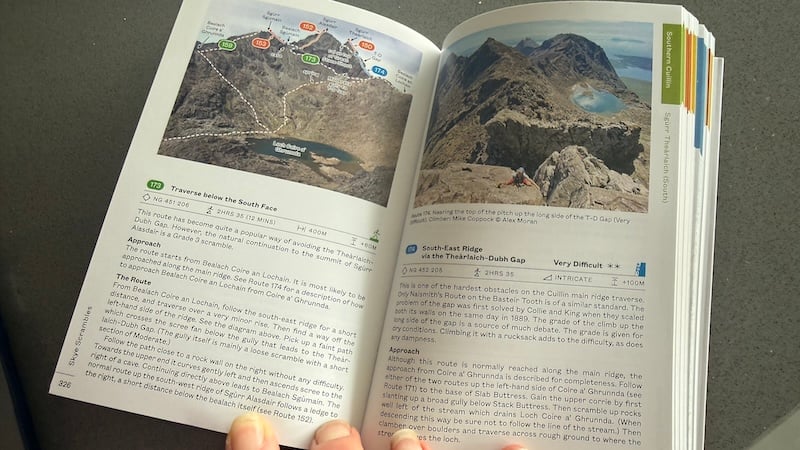
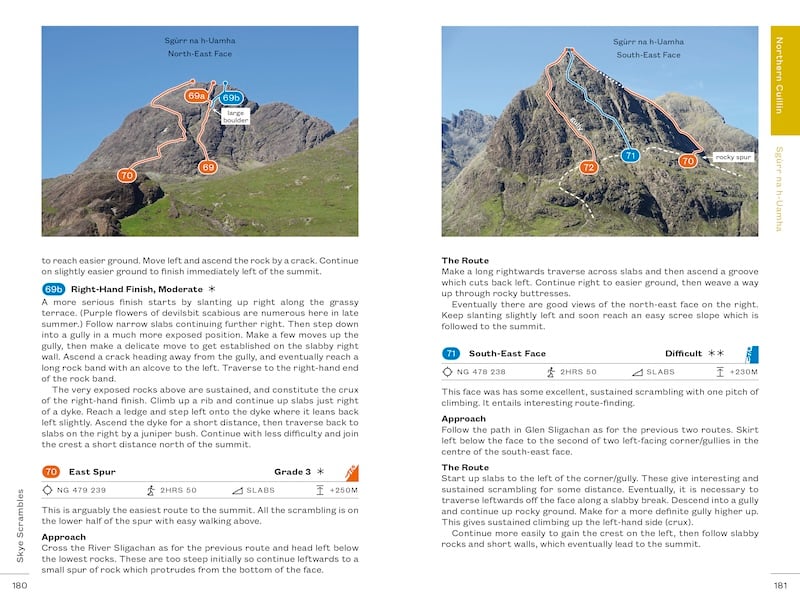
At a glance, the book reveals the grid reference, type of scramble, the time it might take and the elevation gain. There is also a more wordy description that includes the approach and the route.
Many routes are shown as diagrams overlaid on photos. Combined with an OS map for greater clarity, the scrambler can then expect to tackle the route in situ.
Climbing routes
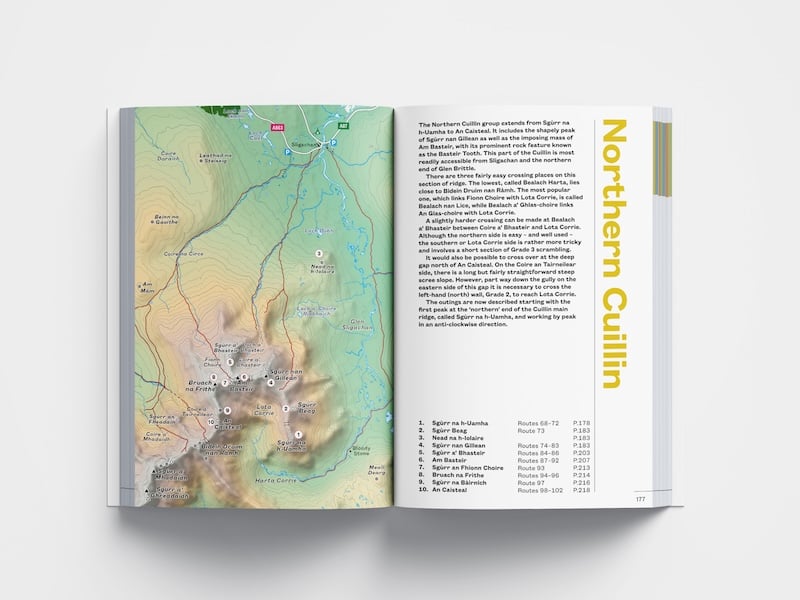
The guidebook offers expansive low-grade climbing options, too, again graded from easier to difficult. There is a dedicated section on the Cuillin Main Ridge Traverse, including mapping.
I am not a climber but my husband, G, is and so I asked for his views on the book. He seemed very happy to absorb himself in a few hours of reading and contemplating. He said: “It’s a really detailed book that, for me, cuts the line between walking and climbing.
“In particular, it’s a great guidebook for those who enjoy the thrill of exposure while still moving quickly without the delay of ropes, or need for a partner.
“I appreciate the detailed grading that helps with assessing risk in order not to over-stretch people’s abilities or nerve.
“The book covers the majority of the main Cuillin ridge in detail and there are options, too, to avoid some classic routes that normally require abseils. For example, The Dubh Ridge has a route that can be scrambled and avoids the need for a rope.
“Overall, there is a good breadth of choice of routes.”
Skye Scrambles – more to read and discover
Another part of the book that I really enjoyed is the first section, with chapters covering geology, human history, wildlife and weather (this is always a big topic on the island), plus Skye’s mountaineering history. There is a lot to learn and I enjoyed the overview.
Any negatives?
I have only a few criticisms. The first is the size of the type face. It’s a small book and so the type is also small. I’d rather a larger format of book.
Also, when you try to lay the book open to read from a page, it’s only possible if you force the spine and I am wary of doing so in case the spine breaks. Instead, you need to hold the book in two hands to keep it open. I am guessing the style of the book comes down to cost.
Finally, I think the book would be much more appealing to a wider range of people if the front cover mentioned “walks” and “climbs” and not just “scrambles”. It sells itself short by not advertising the full breadth of routes.
I confess I would have overlooked the book entirely as “not for me” if I had not been sent a copy to review and then discovered it includes plenty of routes for someone like me.
In conclusion
This is a guidebook that will happily sit on a bookshelf or coffee table for years to come and provide many hours of “flicking through” as walkers and climbers plan trips, looking for new ideas and routes, as well as remembering routes they have already completed.
Skye Scrambles is priced at £27.50 and can be bought from Scottish Mountaineering Press, as well as many other outlets.
Note:
The SMC, which was established in 1889, has been at the forefront of climbing and mountaineering in Scotland for more than 135 years. The club produces a wide range of guidebooks, which are published by the Scottish Mountaineering Press.